What Does a Garment Merchandiser Do?
In the complex world of apparel manufacturing, a garment merchandiser is the critical link that turns a brand’s design vision into a finished, market-ready product. Far more than a coordinator, they are the strategic and operational backbone of successful clothing production—bridging creative intent, commercial goals, and factory execution.
What Is a Garment Merchandiser?
A garment merchandiser is the professional who oversees the entire lifecycle of a clothing product, from initial concept to final delivery. They act as the single point of accountability between fashion brands, design teams, material suppliers, and manufacturing factories.
Unlike designers (who focus on aesthetics) or production managers (who focus on factory floor operations), merchandisers balance three core priorities:
- Commercial viability: Ensuring products meet cost targets and profit margins
- Creative integrity: Preserving the brand’s design intent and quality standards
- Operational reliability: Delivering on time, at scale, and across global supply chains
In short, a garment merchandiser ensures that “what the brand wants” becomes “what the factory can deliver—profitably and on schedule.”
Merchandiser Responsibilities
The role of a garment merchandiser spans every stage of apparel production, with key duties including:
1. Pre-Production & Requirement Alignment
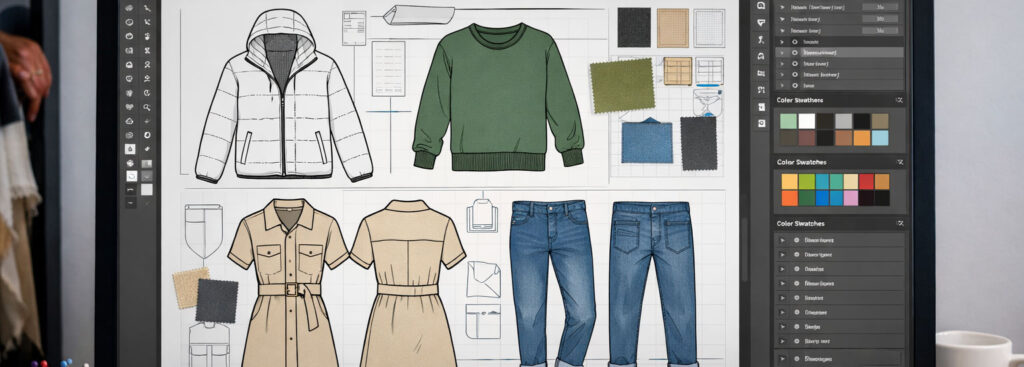
- Translate design sketches and tech packs into actionable production specifications
- Align with brand teams on target costs, lead times, volume, and quality expectations
- Identify potential execution risks (e.g., fabric availability, factory capacity) early in the process
- Define sampling timelines and approval criteria to avoid costly revisions later
2. Material & Sample Management
- Coordinate fabric and trim sourcing, ensuring materials match design specs and cost targets
- Manage the full sample lifecycle: from proto samples to fit samples and pre-production approval
- Track sample revisions, document changes, and secure final sign-off before bulk production begins
- Resolve material compatibility issues (e.g., fabric shrinkage, color fastness) to prevent production delays
3. Production Coordination & Oversight
- Allocate production to suitable factories based on product type, volume, and compliance requirements
- Monitor daily production progress, tracking milestones to keep orders on schedule
- Conduct inline quality checks and address workmanship issues before they become bulk defects
- Manage PO (purchase order) alignment, reconciling brand expectations with factory capacity and material lead times
4. Commercial & Risk Management
- Negotiate pricing with suppliers and factories to maintain cost-effectiveness without compromising quality
- Mitigate risks related to cost volatility, supply chain disruptions, and compliance changes
- Resolve cross-border communication gaps between brand teams and overseas manufacturing partners
- Ensure all production activities align with the brand’s commercial and ethical standards
5. Delivery & Post-Production Follow-Up
- Coordinate shipment preparation, documentation, and logistics to meet delivery deadlines
- Conduct final pre-shipment inspections to confirm quality and compliance
- Support repeat-order continuity, applying lessons learned from previous production runs
- Resolve post-delivery issues (e.g., sizing discrepancies, quality claims) on behalf of the brand
How Merchandising Connects Brands and Factories
At its core, apparel merchandising is the bridge that eliminates friction between brand-side decision-making and factory-side execution.
Brands typically focus on design, marketing, and customer experience—they lack the on-the-ground expertise to manage complex manufacturing workflows. Factories, meanwhile, specialize in production efficiency but often struggle to interpret nuanced design intent or commercial priorities.
A garment merchandiser fills this gap by:
- Translating design into production: Converting creative sketches into measurable specs, measurements, and quality standards that factories can follow
- Aligning priorities: Balancing the brand’s desire for innovation and quality with the factory’s need for clear, feasible production instructions
- Managing expectations: Setting realistic timelines and cost targets, and communicating progress transparently to all stakeholders
- Resolving conflicts: Mediating between brand teams (pushing for perfection) and factories (pushing for efficiency) to find mutually acceptable solutions
Without this merchandising layer, brands risk misaligned production, costly reworks, and missed deadlines—while factories face unclear requirements and inconsistent order flow.
Merchandising in Global Apparel Supply Chains
In global apparel sourcing, the role of a garment merchandiser becomes even more critical. Cross-border supply chains introduce additional layers of complexity:
- Time zone and language barriers: Miscommunication can lead to costly errors in sampling, sizing, or finishing
- Regulatory and compliance differences: Factories must meet regional standards (e.g., BSCI, SEDEX) and import/export regulations
- Longer lead times: Material shipping, production, and logistics require precise timeline management
- Supply chain volatility: Geopolitical shifts, port congestion, and material shortages demand proactive risk mitigation
A skilled global garment merchandiser:
- Navigates cross-border communication with bilingual expertise
- Ensures compliance with international labor, safety, and environmental standards
- Builds buffer time into production and shipping timelines to account for disruptions
- Maintains visibility across multiple suppliers and factories, ensuring consistency across the entire supply chain
This global merchandising function is what turns a fragmented network of suppliers into a cohesive, reliable execution system.
How Buying Offices Support Merchandising
For many fashion brands—especially startups and growing labels—building an in-house merchandising team is costly and impractical. This is where apparel buying offices step in to provide dedicated, scalable merchandising support.
A professional buying office like MINYOO extends the brand’s merchandising capabilities by:
1. Providing On-Ground Expertise
- Local teams in key manufacturing hubs (e.g., China, Vietnam) offer real-time oversight of production
- Bilingual specialists bridge communication gaps between brand teams and overseas factories
- Deep industry knowledge of fabric sourcing, factory capabilities, and regional compliance requirements
2. Delivering End-to-End Merchandising Support
- Managing the full sample lifecycle, from proto development to pre-production approval
- Coordinating PO alignment, production tracking, and quality control across all stages
- Mitigating commercial risks (cost, lead time, quality) through proactive planning and issue resolution
- Ensuring alignment between brand design intent and factory execution
3. Scaling with Your Business
- Flexible support that grows with your order volume, from small-batch startup collections to large-scale global production
- No fixed overhead costs of an in-house merchandising team
- Access to a pre-vetted network of suppliers and factories, curated for product type and compliance
4. Ensuring Accountability & Visibility
- A single point of contact for all merchandising and production needs
- Transparent progress tracking and reporting, keeping the brand in control at every stage
- Full accountability for outcomes, from sample approval to final delivery
In effect, a buying office acts as an extension of your brand’s merchandising team—delivering the expertise, control, and reliability of an in-house function, without the cost and complexity of building one from scratch.
Conclusion
A garment merchandiser is far more than a coordinator—they are the strategic and operational heart of successful apparel production. From aligning brand expectations with factory capabilities to managing global supply chain risk, merchandising ensures that clothing collections are delivered on time, on budget, and true to the brand’s vision.
For brands looking to scale without the overhead of an in-house team, partnering with an apparel buying office provides access to dedicated merchandising expertise, turning complex global sourcing into a streamlined, accountable process.